What Became the Catalyst for Malcolm X to Start Reading
On the Shelf
The Dead Are Arising: The Life of Malcolm X
By Les and Tamara Payne
Liveright: 640 pages, $35
If you buy books linked on our site, The Times may earn a commission from Bookshop.org, whose fees support independent bookstores.
"The Autobiography of Malcolm 10," published shortly subsequently the Black nationalist leader'southward 1965 assassination, was both a literary classic and the foundation of his posthumous public image. But that's been irresolute in the 21st century. This month, for the 2nd time in a decade, a new biography strips away some of the mythmaking to bring a more nuanced Malcolm to the public.
The latest book, similar the activist's reputation, has been long in the making. The projection that became "The Dead Are Arising: The Life of Malcolm 10" was begun in 1990 by journalist Les Payne; afterwards he died in 2018, the terminal edits were overseen by his daughter and lead researcher, Tamara Payne.
Already a National Volume Award finalist, the volume will naturally describe comparisons to Manning Marable's 2011 Pulitzer Prize-winning biography, "Malcolm 10: A Life of Reinvention."
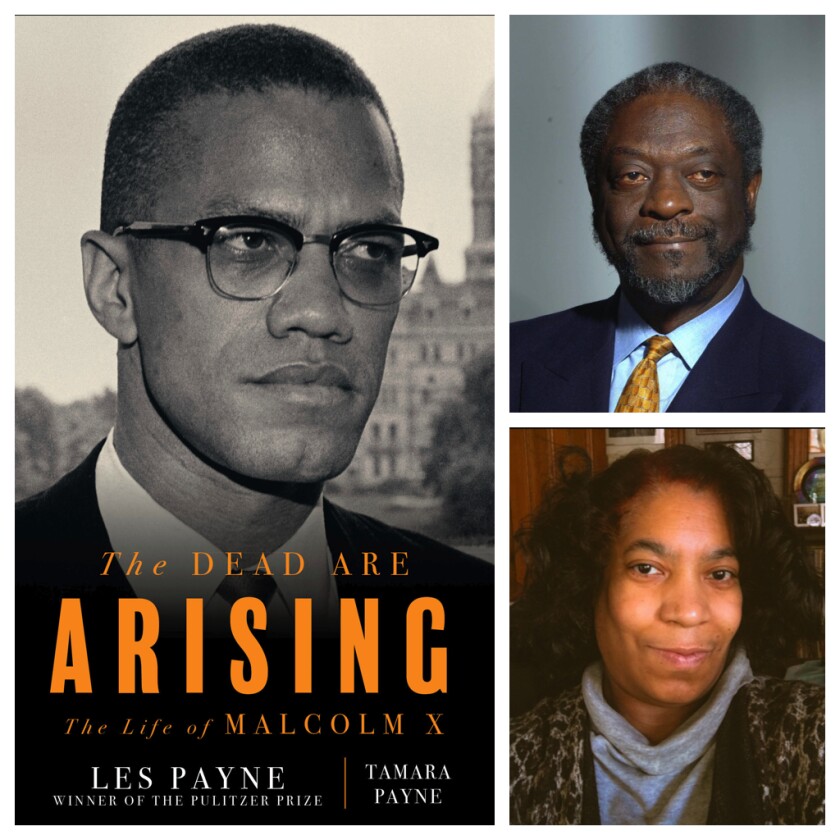
(Liveright/J Conrad Williams Jr./Newsday)
Marable's was the first major work to fully re-examine Malcolm's life in the context of his era — and to depart sharply from the "Autobiography." The Payne book is like in some respects, merely Tamara Payne emphasizes the divergences: "My begetter was a journalist and Marable was a historian, so they're dissimilar disciplines," she says, meaning her book relied more on fresh interviews and less on estimation. Her father embarked on the work afterward interviewing Malcolm's brothers Philbert and Wilfred.
Perceptions of Malcolm change with each generation: His death inspired radicalism in everyone from Martin Luther Rex to the Blackness Panther Political party, even equally he was sidelined past the white mainstream; in the '90s, rap artists and Fasten Lee reinvented him every bit a Che-style rebel poster-child; 20 years after he was Marable's compelling but flawed messenger. And today, with ascent white supremacy countered past Blackness Lives Affair, Malcolm is returning to prominence as a piece of the swell puzzle of the motion: where we go next.
Every accept on Malcolm, nevertheless, measures itself confronting the paradigm consciously engineered past Malcolm himself in his — one that he knew he might not live to run into.
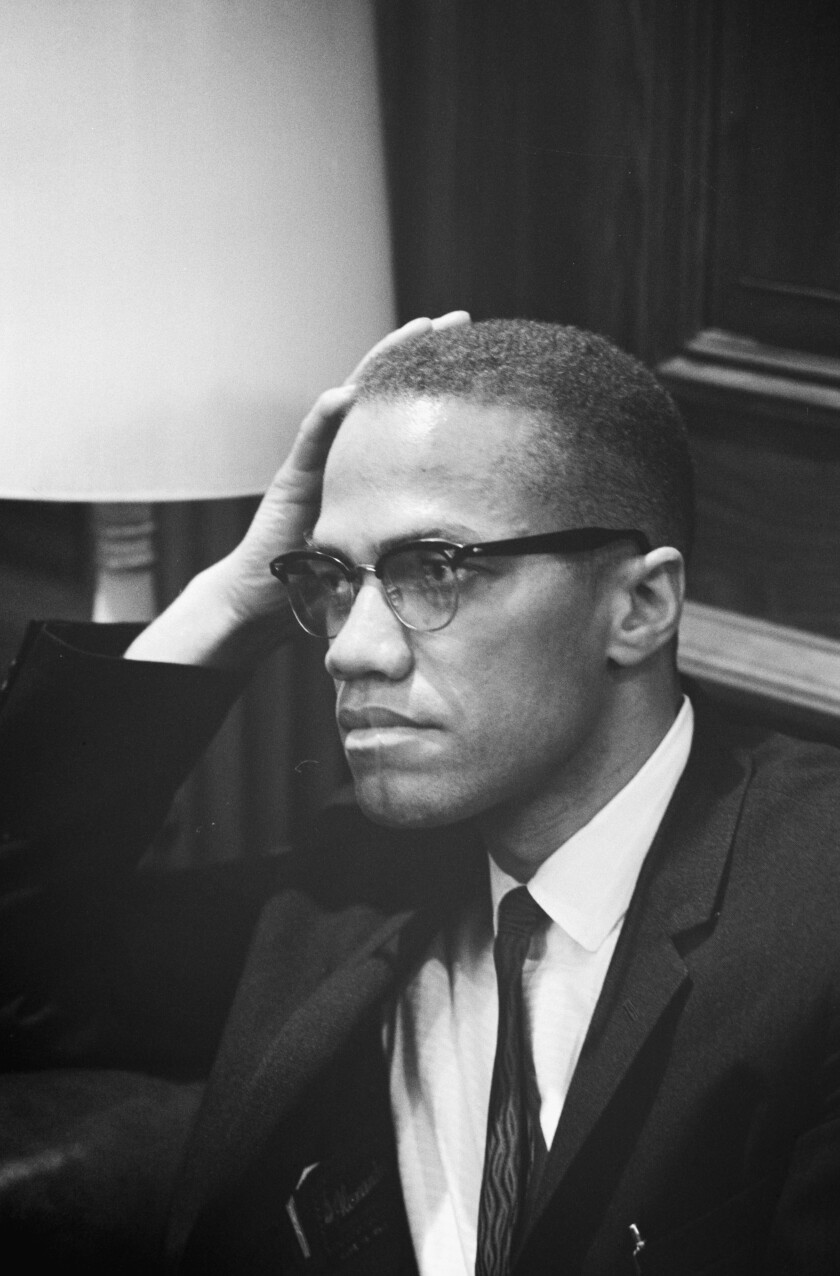
Malcolm X waiting at a printing conference in 1964. From "The Dead Are Arising: The Life of Malcolm X" by Les Payne and Tamara Payne.
(Marion S. Trikosko/Library of Congress)
"[Malcolm] engaged with the media to create the public image," says Morgan State University professor Jared Brawl. "He didn't believe he'd survive and wanted the volume to be something that would endure."
His effort to reverse the narrative was an immediate success, said Zaheer Ali, a scholar who was Marable's atomic number 82 researcher, in an email interview: "Media publications that had belittled Malcolm in unkind obituaries only after his death published rave reviews praising the book and inviting reassessments of his life."
There were, however, complications. For starters, the book set his legacy in stone at a time when his behavior were shifting like sand. Initially a platform for the Nation of Islam, the autobiography evolved radically later Malcolm's split up with the group — a shift amplified by his writer, integrationist moderate Alex Haley, after Malcolm's murder.
Confronting his late partner'south wishes, Haley made numerous changes. He cut i chapter, chosen "The Negro" (only recently made public), which would have given us "a improve sense of where Malcolm felt the movement should be going," says Bill Fletcher, quondam president of the TransAfrica Forum. Written while Malcolm was nevertheless in the NOI, the chapter preached self-conclusion and chastised integrationist activists for allowing whites to dictate terms of societal success; it also urged Black people to have political action by voting as a bloc at a time when the NOI was publicly apolitical.
"With his assassination, Malcolm lost control over what compromises he would have been willing to make in the cease," says Peniel Joseph, author of the new book, "The Sword and the Shield: The Revolutionary Lives of Malcolm X and Martin Luther King Jr."
And yet, as Ball says, "the autobiography, with all of its flaws, remains the defining document."
Scholarship slowed as Malcolm's profile faded in the '70s and '80s, with the notable exception of Peter Goldman'due south "The Death and Life of Malcolm X" in 1973, which Ali calls "a foundational text."
In the tardily '80s, hip-hop (nearly notably Public Enemy) revived him in samples, and a new generation began buying Malcolm posters and wearing Malcolm shirts. But "they only resuscitated role of Malcolm," Fletcher says. "Information technology was like science fiction where a person was brought dorsum from the expressionless but non exactly as what they were before they died. You have snippets from Malcolm'due south life and images rather than a coherent movie."
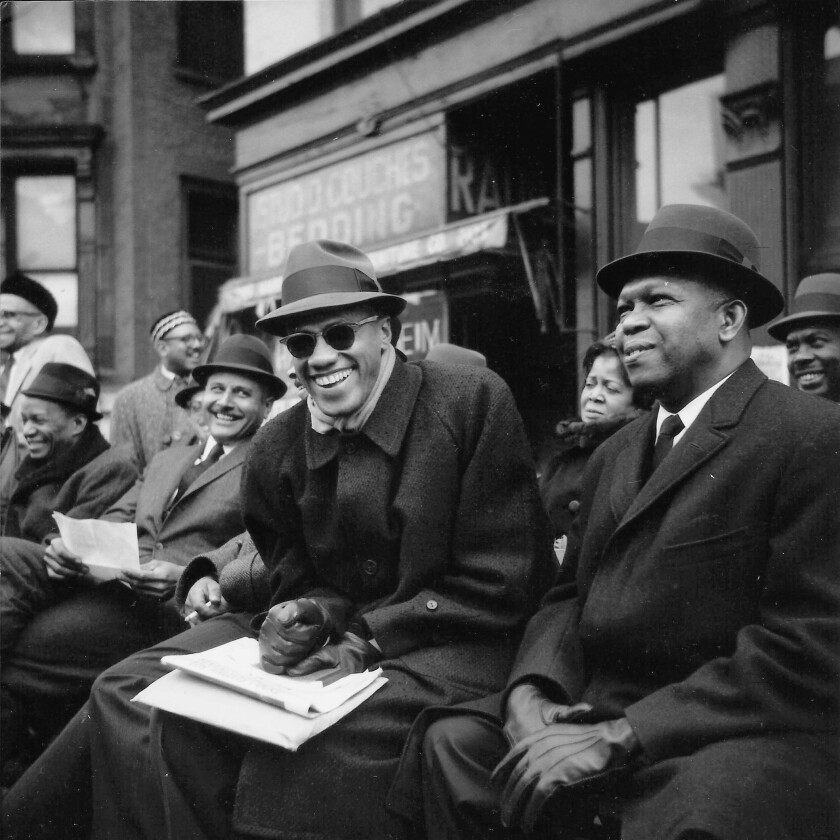
Malcolm 10 (middle) with Percy Sutton (left) and Human Jack (right) at a Harlem rally in 1962.
(O'Neal L. Abel)
Bruce Perry's 1991 book "Malcolm: The Life of a Human Who Changed Black America" attempted to fill up the picture in — refuting parts of the autobiography while sketching Malcolm every bit a tormented soul driven more by inner turmoil than genuine beliefs. Perry did hundreds of interviews, but his volume was attacked as a "hatchet task," riddled with dubious claims about Malcolm'south supposed homosexuality and the idea that he firebombed his own abode.
Other texts during this revival included a well-received book by Michael Eric Dyson and a PBS documentary, just Spike Lee's 1992 picture "Malcolm 10" overshadowed them all.
The scholars I spoke with agreed that the pic lacks nuance and badly shortchanges Malcolm's late political development, but most credit its visceral power for introducing Malcolm to new generations. And yet information technology wasn't really a revision; it relied largely on "The Autobiography."
It took nearly ii decades for a sweeping re-examination of Malcolm's origin story. Marable's comprehensive retelling — Ali says it was the first to make use of his travel diaries — repeatedly debunked the "Autobiography" and shed new light on numerous incidents, including Malcolm'southward assassination.
Gimmicky Black academics like Dyson, Henry Louis Gates and Cornel West endorsed Marable'southward interpretations. Merely radical activists attacked his version every bit as well palatably mainstream. Jared Ball, who edited "A Lie of Reinvention: Correcting Manning Marable'due south Malcolm X," says the historian watered down Malcolm's anti-capitalism and pan-Africanism. (Marable died days before his book's publication.)
Even Fletcher, one of Marable'due south closest friends, acknowledges that the epilogue — which imagines Malcolm'due south future had he lived — was a error. "Such speculation is fine over a drinking glass of Jack Daniel's, but it's not peculiarly useful in a scholarly book."
Marable also fabricated some salacious claims — that Malcolm slept with men for pay; that his split with Elijah Muhammad stemmed from a love triangle; that both Malcolm and his wife, Betty Shabazz, had diplomacy and that Malcolm's included one with an 18-year-old girl the nighttime before he died. Unsurprisingly, the true believers were furious, dismissing these generally as unsubstantiated tabloid gossip.
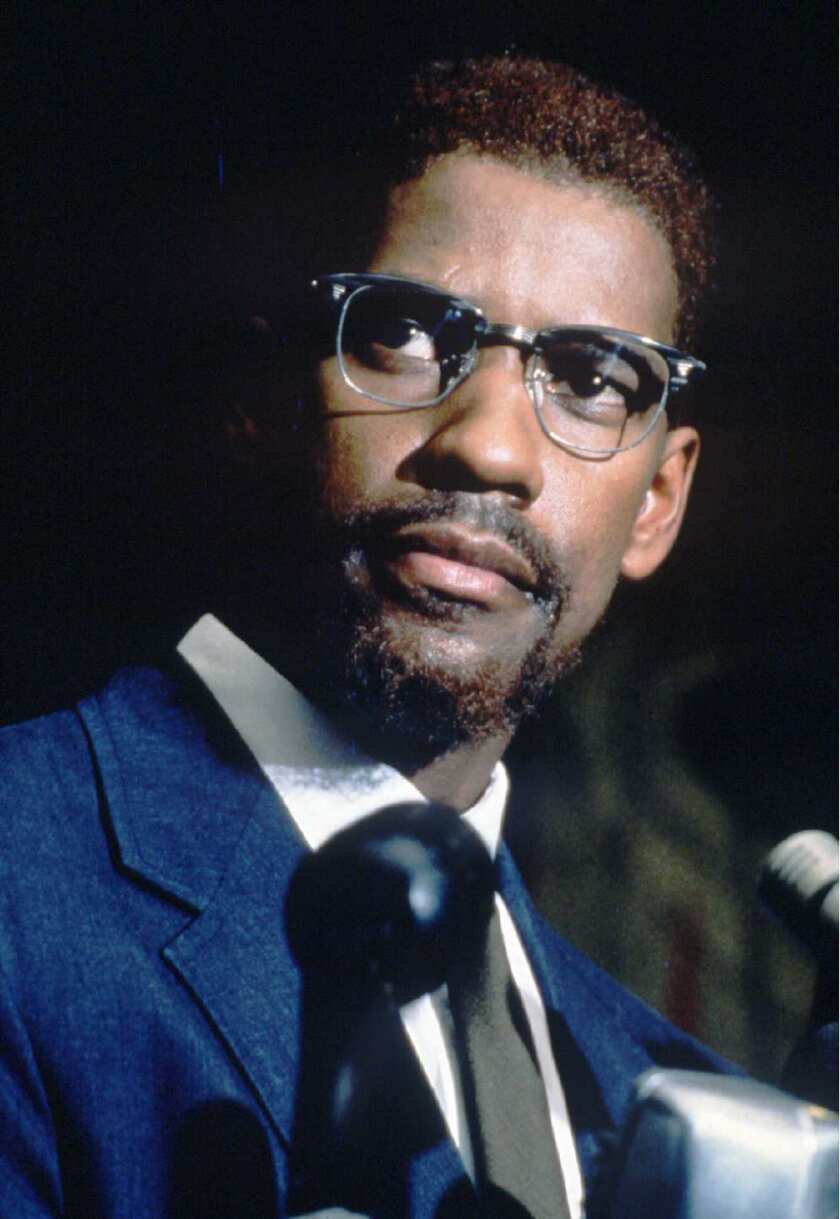
Denzel Washington starred in Spike Lee's defining motion-picture show "Malcolm X."
(David Lee / Warner Bros.)
"Marable presents a very complicated person with complicated relationships," says Fletcher in his defense force, pointing out that these entanglements had huge implications. Shabazz may have been sleeping with an undercover agent; the 18-year-onetime was, Marable claimed, linked to Malcolm's killers. Fletcher believes the love triangle explains "why he did things that were overly provocative, putting himself in real danger."
That'southward fair game if those statements were irrefutably true. But these assertions were amongst the worst sourced sections of the book, riddled with qualifiers; some intimations have either no clear sources or unreliable ones like Louis Farrakhan, a Malcolm enemy.
Reached for comment, editors Wendy Wolf and Kevin Doughten would not address accuracy or sourcing. But in an email statement, they responded: "Manning was clear-eyed in his approach to the different views people have held of Malcolm for decades. He knew the backlash was coming and welcomed information technology — he wrote with the confidence of deep research and long feel and was looking forwards to the conversations."
The Paynes' book arrives in a dissimilar fourth dimension, amid a new resurgence — every bit Black Lives Matter activists, working alongside and likewise apart from white liberals, aim to maintain pressure for substantive changes. Malcolm is a major grapheme in the 2019 Epix series "Godfather of Harlem" and the upcoming film "One Night in Miami ." This year, in addition to Joseph'south book, nearly how Malcolm and Martin Luther King had begun to converge, there was an acclaimed Netflix documentary serial, "Who Killed Malcolm X."
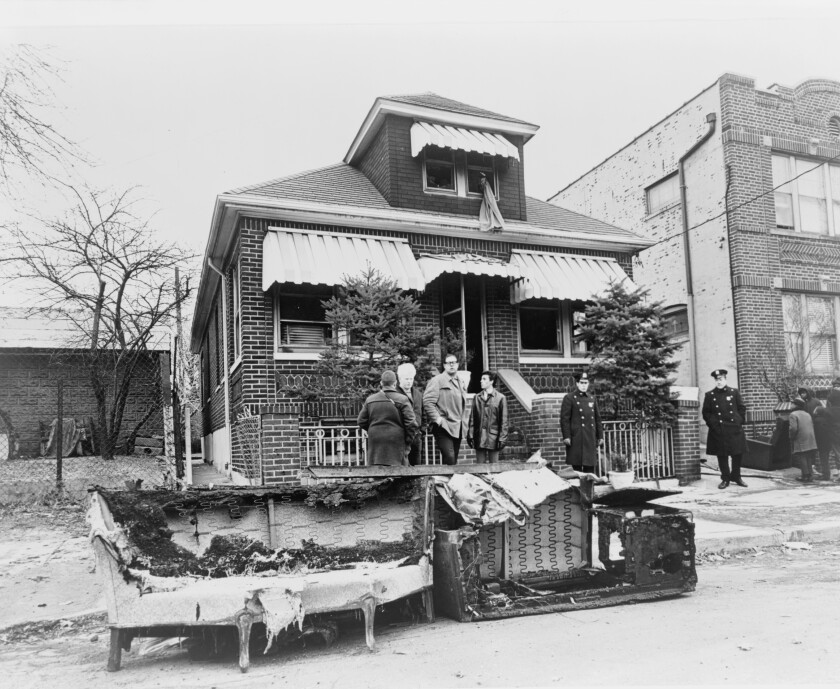
Exterior view of home of Malcolm X with charred piece of furniture in the foreground, February 1965.
(Stanley Wolfson/Library of Congress)
"The Dead Are Arising" offers only a partial corrective to earlier works, an incremental turn in the long-evolving story of one of history'south most visible and confounding activists. Payne frequently revises or expands the historical record, offering the most detailed new business relationship of Malcolm'southward early years; the clearest statement nevertheless (with new sources) that Earl Little, Malcolm'south male parent, died in an accident and not in a racist murder; the revelation that Shorty (the friend played by Fasten Lee in the pic) is really a composite; a deep swoop into Malcolm'due south sick-advised meeting with the Ku Klux Klan; and intriguing specifics on the assassination and its aftermath.
But the Paynes don't touch Malcolm's intimacies or examine his legacy. The book sometimes feels incomplete, leaving out crucial moments. Tamara Payne says they avoided speculation on sexuality, explicit corrections of earlier work and certain well-known stories for several reasons. "If you tin't go information technology corroborated as authentic, you don't have it," she says. "Also the book would be 1,000 pages otherwise ... it'due south already longer than my father wanted."
Ultimately, the scholars agree that there's no such thing as a definitive biography, especially with more information still to be discovered and analyzed. Just they promise that in this new era of racial reckoning, Malcolm's story and his ideas remain front and center. "People should view the 'Autobiography' and his speeches every bit the starting point," Payne says, "and go from there."
Source: https://www.latimes.com/entertainment-arts/books/story/2020-10-20/the-long-history-of-malcolm-x-histories
0 Response to "What Became the Catalyst for Malcolm X to Start Reading"
Post a Comment