Tidalectics Imagining an Oceanic Worldview Through Art and Science
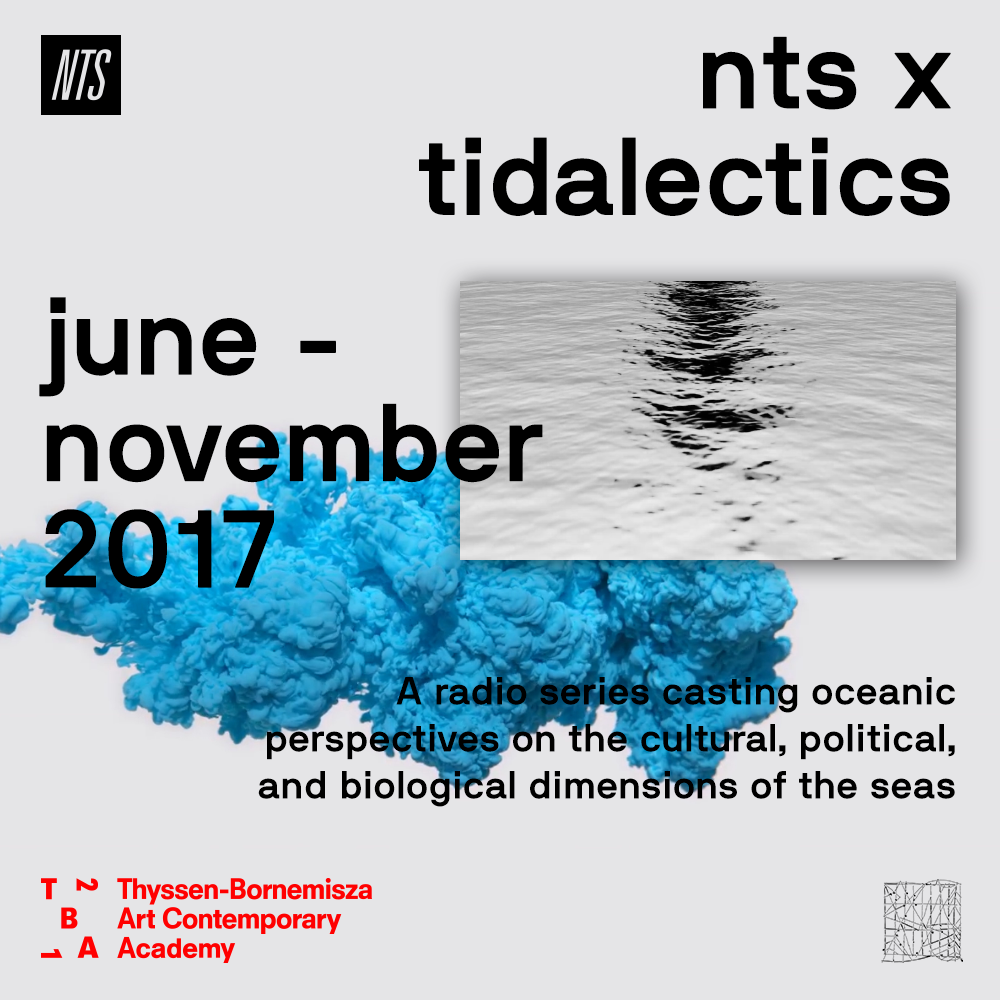
Tidalectics is an experiment to formulate an oceanic worldview, a different fashion of engaging with the oceans and the world we inhabit. Unbound by land-based modes of thinking and living, the exhibition is cogitating of the rhythmic fluidity of water and the incessant swelling and receding of the tides. Tidalectics emerges from the Thyssen-Bornemisza Art Gimmicky (TBA21)–Academy, a site of cultural production without a fixed locale, moving aboard the Dardanella research vessel, temporarily inhabited by artists, scientists, and other thinkers and practitioners. Since 2011, the University'southward program is entirely defended to fostering engaged ways of caring for the oceans. If our thoughts and actions as mostly state-habitation humans fail to grasp these vast bodies of water that cover 2 thirds of our planet, let lone accept intendance of them, possibly it is time to consider other, oceanic, means of being. Tidalectics sets out to practise exactly that.
The exhibition takes its championship from a play on words past the historic Barbadian poet and historian Kamau Braithwaite. With Tidalectics, Brathwaite crystallizes our terrestrial "obsession for fixity, assuredness, and appropriation" (Franco Cassano) and mirrors instead the fluctuating rhythmic soundings of the waves at sea and their curling ripples as they wash onto the shores. If dialectics is the fashion that "Western philosophy has causeless people'south lives should be," (Brathwaite) then Tidalectics delves into deeper layers of meaning, involving a range of different readings and interpretations—for water is a transitory chemical element, and a "beingness dedicated to h2o is a beingness in flux" (Gaston Bachelard). Brathwaite's poetry radiates with music and rhythm. Information technology is crafted on "riddims" that are deeply rooted in (mail service-)colonial anger and promise. A cardinal thinker of creolization, Brathwaite makes us aware that hybridization is not restricted to land, just begins in maritime spaces and at the coast. Just like navigators who land at a new shore, bringing with them their living and constantly shifting stories, myths, and behavior, the concept of Tidalectics can migrate from its original context in Brathwaite's writing to other geographies and realms. The exhibition advisedly transfers the term, mindful not to obscure its specificity but considering the notion equally starting bespeak for an oceanic worldview.
The exhibition is an attempt to liquefy our ways of existence, to plow to and immerse ourselves—even if we stay dry for at present—in the water covering our planet, where movement and flux prevail over static halts. Tidalectics merges the anchored with the afoot and moves dorsum and forth between being waterborne and touching country. It seeks to cover our histories every bit trajectories tossed by waves, from ocean crossings to systems of substitution, myths, and microbial origins.
Each of the artists in the exhibition appoint in their ain particular means with the diverse questions emerging from the archipelago of cultural, political, and biological predicaments. Tidalectics is about poiesis, creation, and unresolved processes taking place before the eyes of the viewers. Information technology mirrors the experimental methods of work of the Academy, in which open-ended situations and collaborative modes are incited to create new ways of being and knowing. As our world is becoming more than oceanic—or, more precisely, as the Oceanian awareness of the significance of the waters for our history and hereafter is streaming out to other geographies—nosotros are becoming more receptive to the liquid dimensions of our existence. Tidalectics offers us the tools to recall through the dissolving notions of time and space, the blurring divisions betwixt land and water, contemporaneity and history, scientific discipline and poetics also as the coalescing human and more-than-man relationships—and to dive together into the bounding main of possible futures.
Artists
Atif Alike, Darren Almond, Julian Charrière, Em'kal Eyongakpa, Tue Greenfort, Ariel Guzik, Newell Harry, Alexander Lee, Eduardo Navarro, Sissel Tolaas, Janaina Tschäpe & David Gruber, Jana Winderen, Susanne Grand. Winterling
Curated by Stefanie Hessler
The exhibition is on view at TBA21–Augarten, Vienna, from June 2–November 19, 2017.
Source: https://www.nts.live/editorial/tidalectics
0 Response to "Tidalectics Imagining an Oceanic Worldview Through Art and Science"
Post a Comment